M41
This cluster in Canis Major is visible as a hazy patch to the naked eye just below Sirius. M41 is resolvable in binoculars and appears fairly loose in telescopes at low power. Some sources say it was observed by Aristotle, but it was not, reading his notes he refers to a star with a tail and M41 does not look like this but a Collinder object below does. Giovanni Batista Hodierna was the first to catalog the cluster, some time before 1654. It became generally known after John Flamsteed’s independent rediscovery in 1702,The cluster was independently found again by Le Gentil in 1749, and also apparently by Charles Messier, who added it to his catalog in 1765.
Messier 41 has a visual magnitude of 4.5. It contains about 100 stars, scattered over an area 38′ in diameter. The brightest, situated near the cluster’s center, is of magnitude 6.9.
Messier 41 has a visual magnitude of 4.5. It contains about 100 stars, scattered over an area 38′ in diameter. The brightest, situated near the cluster’s center, is of magnitude 6.9.
On clear dark nights, M 41 is visible to the naked eye as a hazy patch virtually the size of the full moon. Binoculars partially resolve it, and it is a fine object at low power in small telescopes. Some of the star chains form together to compose a backward question mark. Other bright cluster members lie in the shape of a parallelogram.
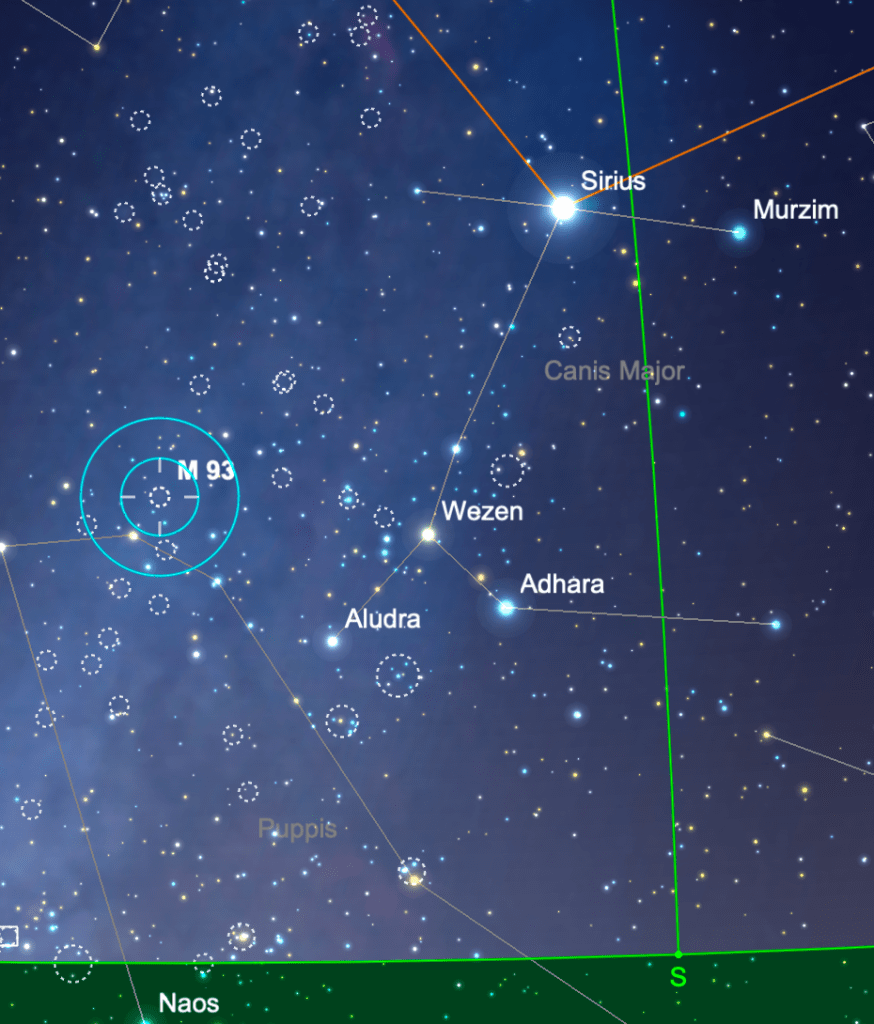
M93 – 6th Magnitude 22 arc Minutes in Size
This is a small fuzzy patch of light in Puppis, partially resolvable in binoculars. The hardest part of finding this cluster in binoculars is picking it out of a fairly rich region of the milky way. Use low power to examine this cluster and the surrounding richness in a telescope. Medium power provides a nice view of the cluster itself.
Messier 93 (NGC 2447) is an open star cluster in constellation Puppis. It was discovered personally by Charles Messier, and cataloged by him in March of 1781.
Messier 93 is about 1° northwest of the 3rd magnitude star 7 Puppis. It is nearly as bright (magnitude 6.0) but less dense than the nearby open cluster M 46. Messier 93 is a rich, luminous, wedge-shaped group; it contains 80 stars of 8th magnitude and fainter in an area 22′ in diameter. The stars are grouped in a triangle pointing to the southwest. A few brighter cluster members are scattered east and west and of the wedge.
M47 – 5th Magnitude 30 arc minutes

A bright cluster in Puppis, easily visible as a hazy patch to the naked eye. Binoculars show a large hazy patch with many stars resolved overtop. Telescopes show a fairly loose cluster with stars of different magnitudes.
M 47 was first observed by Giovanni Batista Hodierna around 1654, but this fact remained unknown until Hodierna’s observations came to light in 1984. Charles Messier independently discovered the cluster in 1771. There is actually no cluster in the position indicated by Messier but if the signs of Messier’s coordinate differences are changed, the position matches that of NGC 2422.
Despite Messier’s error, Caroline Herschel observed and identified M 47 in early 1783. William Herschel also independently rediscovered M 47 in 1785. It survived in many catalogs, including John Herschel’s (GC 1594) and Dreyer’s (NGC 2478). As John Herschel put it in his Notes on the GC, “This cluster has not since been observed. It is probably a very loose and poor one.” M 47 remained a missing object until 1959, when it was identified as NGC 2422 by T. F. Morris (along with the also-missing M 48).
Visually, M 47 is a large, bright cluster of magnitude 5.2, visible to the unaided eye as a hazy patch in the Milky Way. There are about 50 stars in the cluster, scattered over an area 30′ across – the same size as the full moon. The cluster is coarse and is irregular, containing knots and chains separated by several starless voids. Its brightest star is of magnitude 5.7; it also contains the fine double Struve 1121, with components of magnitude 7.9 separated by 7.4″.
M46 – 6th magnitude , 20 arc minutes
This cluster is beside M47 and is also visible to the naked eye. In binoculars M46 appears as a large hazy patch with no stars resolvable, giving a nice contrast to M47. In telescopes at low powers this cluster evenly fills the eyepiece. While you are here go to medium or high power and look for the planetary nebula NGC2438. It will appear as a faint uneven ring, with a blue/green color. The planetary appears to lie within the cluster, but is most likely unrelated.
M 46 was discovered by Charles Messier in 1771. Messier added it to his catalog three days after publishing the first edition of his list (containing M 1 – M 45). Dreyer described M 46 in the NGC as “very bright, very rich, very large.”
M 46 appears in a rich region of the Milky Way in northern Puppis, about 1.5 degrees east of M 47. The two clusters fit well in a binocular or wide-angle telescope field. M 46 is very rich, with 150 stars of magnitude 10 – 13, and probably a total population over 500 stars. Its members are scattered over an angular diameter of about 27′; the brightest is of apparent magnitude 8.7. The cluster has a total visual magnitude of 6.0.
Properties and Planetary Nebula
M 46 lies at a distance of about 5,400 light years, implying a linear diameter some 30 light years across. Its brightest stars are of spectral type A0, and about 100 times more luminous than the Sun. This indicates an age of about 300 million years.
Planetary nebula, NGC 2438, appears within the cluster, near its northern fringes. However, this nebula is probably not a member, for several reasons. NGC 2438 is receding from us at about 77 km/sec, much faster than the cluster’s radial velocity of 41.4 km/sec. The difference would not allow the cluster’s gravity to hold the nebula, even if they were at the same distance. And with a derived distance of about 2,900 light years, the planetary a foreground object several thousand light years closer than the cluster.
Moreover, planetary nebulae are late states in stellar evolution, visible only for a few thousands of years before their material disperses into interstellar space. They occur only for stars of less then 3 solar masses (more massive stars go supernova). These stars, however, need more than a billion years to evolve until they eject their envelope to form the planetary. This is much longer than the age of M 46.
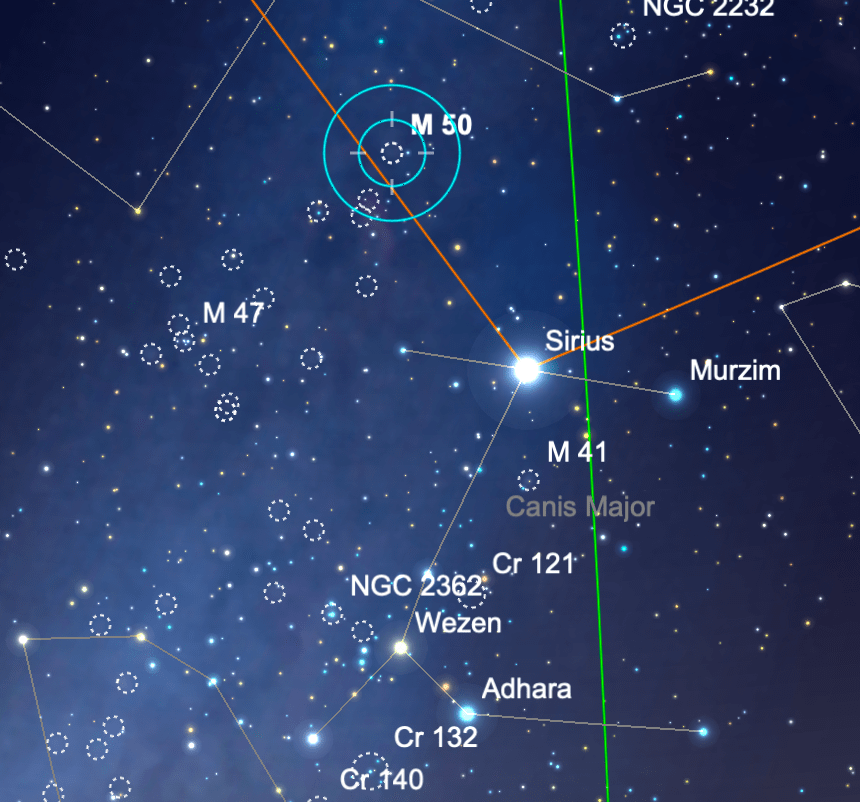
M50 – 6th magnitude in Monoceros 15’
An open cluster in Monoceros. This is a small hazy patch partially resolved in binoculars. Like M93, the richness of the surrounding field is the only difficulty in finding this object. This is a fairly tight cluster at low power in a telescope.
M 50 was discovered in 1710 by Cassini, the famous observer of Saturn; Charles Messier rediscovered it in April of 1772 while observing a prominent comet.
M 50 is an impressive cluster of magnitude 5.9, visible in binoculars as a bright concentration of stars. It contains 200 members, of 8th magnitude and fainter, in an area about 15′ x 20′ in diameter. There is a string of stars in the north-south direction, and a rich heart-shaped concentration at the center, offset by a starless void to the north.
A red giant 7′ south of the center contrasts prominently against its blue-white neighbor stars. The cluster also contains some yellow giants.
M48 – 6th magnitude, 30 arc minutes
Moving on to Hydra, we find another naked eye cluster. M48 is a large partially resolvable fuzzy patch in binoculars. Use low to medium power in your telescope for a spectacular view.
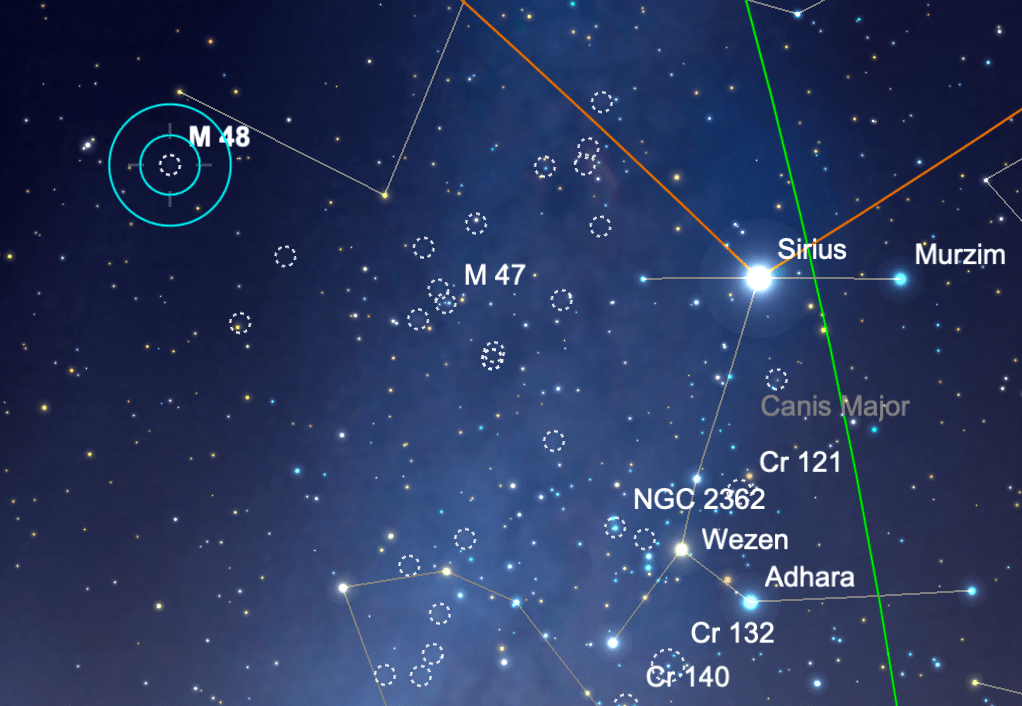
Messier 48 (NGC 2548) is a conspicuous open cluster in Hydra, visible to the naked eye under good atmospheric conditions. Despite this, Messier 48 has long been thought to be one of the “missing” Messier objects.
This open cluster was catalogued by Charles Messier in 1771. However, there is actually no cluster in the position indicated by Messier. The value that he gave for the right ascension matches that of NGC 2548; however, his declination is off by five degrees. The object remained missing until identified by Oswald Thomas in 1934, and independently by T.F. Morris in 1959.
While M 48 was lost, two independent rediscoveries occurred. First, Johann Elert Bode apparently found it on or before 1782; second, Caroline Herschel independently rediscovered M 48 in 1783, and added it as No. 5 to her small list. This latter discovery was published by Caroline’s famous brother, William Herschel, who included it in his catalog as H VI.22 in 1786. Thus credit for M 48’s discovery is sometimes given to Caroline Herschel in 1783 instead of Messier.
The thinking today is that Messier was really looking at NGC 2548, and had made an error in reporting his observation. The cluster NGC 2548 fits his description of Messier 48, though it is 5° south of the position Messier reported in 1771.
Appearance and Properties
Located in the head of Hydra, almost on its western border with Monoceros, M 48 is quite a conspicuous object. With a total visual magnitude of 5.5, it should be a naked-eye object under good conditions. It is an ideal target for high power binoculars or the smallest of telescopes. The cluster contains about 80 stars, of which about 50 are brighter than magnitude 13. The more concentrated core extends over 30′, while the outskirts reach out to about 54′.
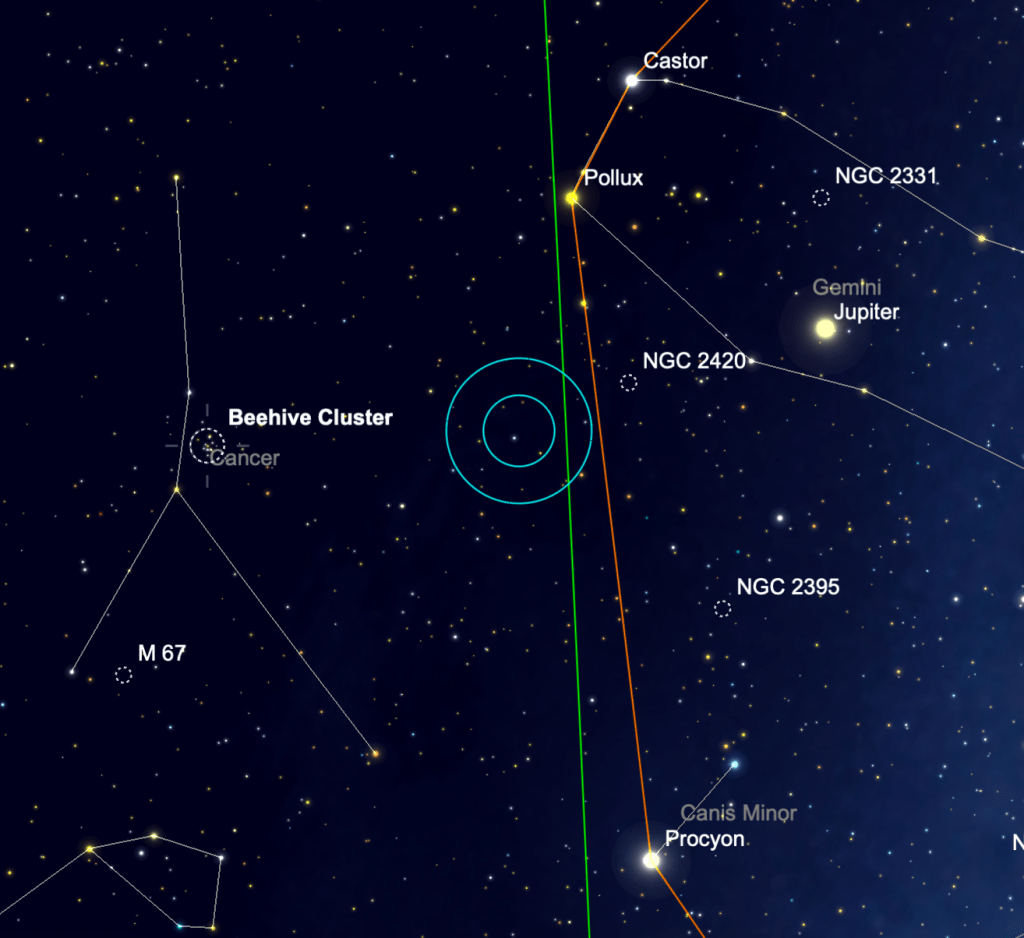
M67 – 7th magnitude – 25’
In the southeast portion of Cancer is one of the most ancient star clusters known and easily visible as a fuzzy patch to the naked eye and . Binoculars show M67 as a large hazy patch of light, similar to M46. Use low power to resolve this large, rich cluster in a telescope.
Messier 67 was discovered by Johann Gottfried Koehler around 1779; however, Koehler’s instruments were unable to resolve this cluster. Charles Messier independently rediscovered it, resolved it into stars, and cataloged it as M 67 in April of 1780.
In small instruments, Messier 67 is a beautiful, bright cluster! With a total visual magnitude of 6.1 and overall dimensions of 30′ – the size of the full Moon – M 67 makes an excellent target for binoculars or small telescopes. It is quite rich, with nearly a hundred 10th to 14th magnitude stars. Its members are distributed in several clumps, one of which is on the cluster’s southern edge near the brighter stars. At 150x, Messier 67 shows some beautiful star chains, and several obvious dark lanes that meander like rivers through the cluster. A magnitude 7.5 star appears near its northeast edge.
Most open clusters are distributed along or near the plane of our Galaxy’s spiral disk; but M 67 is so old that it has worked its way 1,500 light-years off the plane of the Milky Way, out to the fringes of its spiral disk where there is little obscuring gas and dust.
M 67 is the nearest old open cluster, and thus has become a standard example for studies of stellar evolution. M 67 contains more than 100 stars similar to the Sun, eleven bright K-type giants, many red giants, and nearly 200 white dwarfs. Its total membership has been estimated at over 500 stars.
M44 – 3rd Mag. 70”
Known as the Praesepe or Beehive Cluster, this open cluster is easily visible to the naked eye as a large, fuzzy patch bigger than the moon. Binoculars or rich field telescopes provide the best view of M44. It is one of the nearest open clusters to our Solar System. The cluster’s age and proper motion coincide with those of the Hyades open cluster, suggesting that both share a similar origin.
Altogether, the Beehive probably contains at least 1000 members, with a total mass of 500 – 600 Suns. The age of the Praesepe is estimated at 600 to 730 million years. This is very similar to the age of another famous naked-eye cluster, the Hyades in Taurus (estimated at 625 to 790 million years old). Interestingly, these two clusters also have a very similar direction of proper motion. Although they are now separated by hundreds of light-years, they probably share a common origin in some great diffuse gaseous nebula. This would also explain the similarity of their stellar populations.
the Greek poet Aratos mentioned this object as “Little Mist” in 260 B.C., and Hipparchus included it in his star catalog as the “Little Cloud” or “Cloudy Star” in 130 B.C. The classical Greek astronomer Ptolemy described it in his Almagest as the “Nebulous Mass in the Breast of Cancer”; to the Greeks, it was known as Phatne.
The Latin translation for Phatne is Praesepe, which means “manger”. The ancient Greeks and Romans saw this cluster as a manger from which two donkeys, the adjacent stars Asellus Borealis and Asellus Australis are eating. Eratosthenes reported that these two “Aselli” (asses) are the donkeys which the gods Dionysos and Silenus rode into battle against the Titans. Their braying frightened the Titans, enabling the gods to win; as a reward, they were placed in sky, along with their Phatne.
The Praesepe appeared on Johann Bayer’s charts as “Nubilum” (“Cloudy”) around 1600. But its true nature remained a mystery until Galileo looked at the cluster through his newly-invented telescope, in 1609. He reported: “The nebula called Praesepe is not one star only, but a mass of more than 40 small stars.”
Charles Messier added the Praesepe as the 44th object in his catalog on March 4, 1769. Messier’s inclusion of the Praesepe is curious, as most of Messier’s objects were much more easily confused with comets. Messier may simply have wanted a larger catalog than his scientific rival Lacaille.
The Beehive is most easily observed during evenings from February to May, when Cancer is high in the sky. To the naked eye it looks like a fuzzy spot. M 44 cannot be resolved with the unaided eye, but with binoculars or a small telescope, one can count at least 75 stars. At 95′ across, it fits well into the field of view of such instruments.
The cluster has a visual magnitude of 3.7. Its brightest members are yellow-white stars of magnitude 6 to 6.5; they include 42 Cancri, the eclipsing binary TX Cancri, the metal-line star Epsilon Cancri, several Delta Scuti-class variables of magnitudes 7 to 8, and one peculiar blue star.
Larger telescopes reveal that more than 200 of the 350 stars in the region of sky covered by the Praesepe are actually members, confirmed by their common motion. Others are foreground or background stars, or may not yet have had their membership determined.
M81 – 6.7th magnitude 22×11”

M82 – 8th magnitude 11×5”
This pair of galaxies in Ursa Major are very possible to see in binoculars, they look like a pair of fuzzy stars. Both galaxies will fit into the same low power telescope field. M81 will appear as a large oval gray patch of light. M82 is a pencil like streak of light next to and perpendicular to the long axis of M81.
It forms a physical pair with its neighbor, M 82, and is the dominant galaxy of the M81 group. Discovered along with M 82 by Johann Bode, and sometimes referred to as Bode’s Nebula, M 81 is one of the easiest and most rewarding galaxies for amateur astronomers in the northern hemisphere.
M 81 was first discovered by Johann Elert Bode, who found it, along with M 82, in 1774. Bode described it as a “nebulous patch”, which “appears mostly round and has a dense nucleus in the middle.” Pierre Méchain independently rediscovered both galaxies in 1779 and reported them to Charles Messier, who added them to his catalog in 1781.
With a total visual magnitude of about 6.7, M 81 can easily be found with binoculars and small telescopes. Under exceptional seeing conditions, it has even been glimpsed with the naked eye by experienced observers. M 81 appears as an elongated, diffuse 20′ x 10′ oval patch in small telescopes, its periphery of rather low surface brightness. With averted vision, broad, diffuse, indistinct spiral arms can be glimpsed.
Telescopes with apertures of 8 inches or larger are needed to distinguish structure in the galaxy, and show a striking example of a “grand design” spiral galaxy. Near-perfect arms spiral into the core, a blazing 3′ x 2′ oval containing a bright 30″-diameter nucleus. To the SSE of the core, separated from it by a dark gap, is a thin spiral feature. The spiral arm NNW of the core is wider and much shorter. Wide dust lanes stretch outward to the edge of the disk.
M 81 is the brightest of a group of 34 galaxies called the Messier 81 Galaxy Group. The distance to the center of the cluster is about 12 million light years. It is the second nearest galaxy group to our Local Group (after the Sculptor Galaxy Group, about 8 million light years away). The M 81 Group includes, in addition to its two Messier members, NGCs 2976 and 3077 in Ursa Major, NGCs 2366 and 2403 in Camelopardalis, and NGC 4236 in Draco.
A few hundred million years ago, a close encounter took place between M 81 and its smaller neighbor, M 82, during which the latter was dramatically deformed. The encounter has also left traces in the spiral pattern of M 81. The galaxies are still close together – their centers separated by as little as 150,000 light-years.
M 81 is still gravitationally interacting with Messier 82 and NGC 3077. The interactions have stripped some hydrogen gas away from all three galaxies, leading to the formation of filamentary gas structures in the group. Moreover, the interactions have also caused some interstellar gas to fall into the centers of Messier 82 and NGC 3077, which has led to strong starburst activity in the centers of these two galaxies.
Because of its proximity and large size, Messier 81 is also a popular target of professional astronomers. The Spitzer Space Telescope has observed infrared emission from interstellar dust in M 81’s spiral arms. This interstellar dust is associated with star formation regions, whose hot, short-lived blue stars are very effective at heating the dust. M 81 has an active galactic nucleus, which harbors a supermassive, 70-million-solar-mass black hole.
In 1994, investigations indicated that M 81 contains little dark matter. For many galaxies, including our own Milky Way, the rotation rate increases outward with distance from the core. However, the total observed luminous matter – stars and nebulae – is typically insufficient to explain this behavior; thus it is assumed that a significant portion of mass in such galaxies is non-luminous, dark matter. In contrast, M 81’s rotation rate was found to decline in the outer regions. Thus for M 81, the percentage of dark matter is now estimated to be lower than average.
Only one supernova (SN 1993J) has been discovered in Messier 81, by F. Garcia in Spain, but reached a maximum brightness of about magnitude 10.5, and was the second-brightest supernova observed in the 20th century. In 1995, astronomers found about 70 candidate globular clusters in the region around M 81, and estimated a total population at 210 globulars.
Messier 82 (NGC 3034) is a remarkable, peculiar galaxy in Ursa Major. M 82 was discovered along with its partner M 81 by Johann Bode, and both galaxies are sometimes known as Bode’s Nebulae. Also called the Cigar Galaxy, M 82 has been spectacularly disturbed by a relatively recent encounter with M 81, and displays conspicuous dust lanes and heavy star formation. M 82 is the prototype irregular starburst disk galaxy.
Messier 82 is relatively bright, at magnitude 8.4. It appears only 38′ north of M 81, and can be seen in the same field of view with binoculars or a low power telescope. This magnificent cigar-shaped galaxy has a 9′ x 4′ halo, and contains a 5′ core extended along its major axis. Because of its high surface brightness, the halo has a well-defined outline. The core is very irregular in profile, and severed into two almost equally long parts by a diagonal dark band.
The western part of the core is brighter and is studded with short dark streaks jutting out at different angles. The eastern half of the core has the largest unbroken area. Several bright knots are strung along the major axis; a couple appear nearly stellar at their sharpest points of concentration.
 The Actual Astronomy Podcast