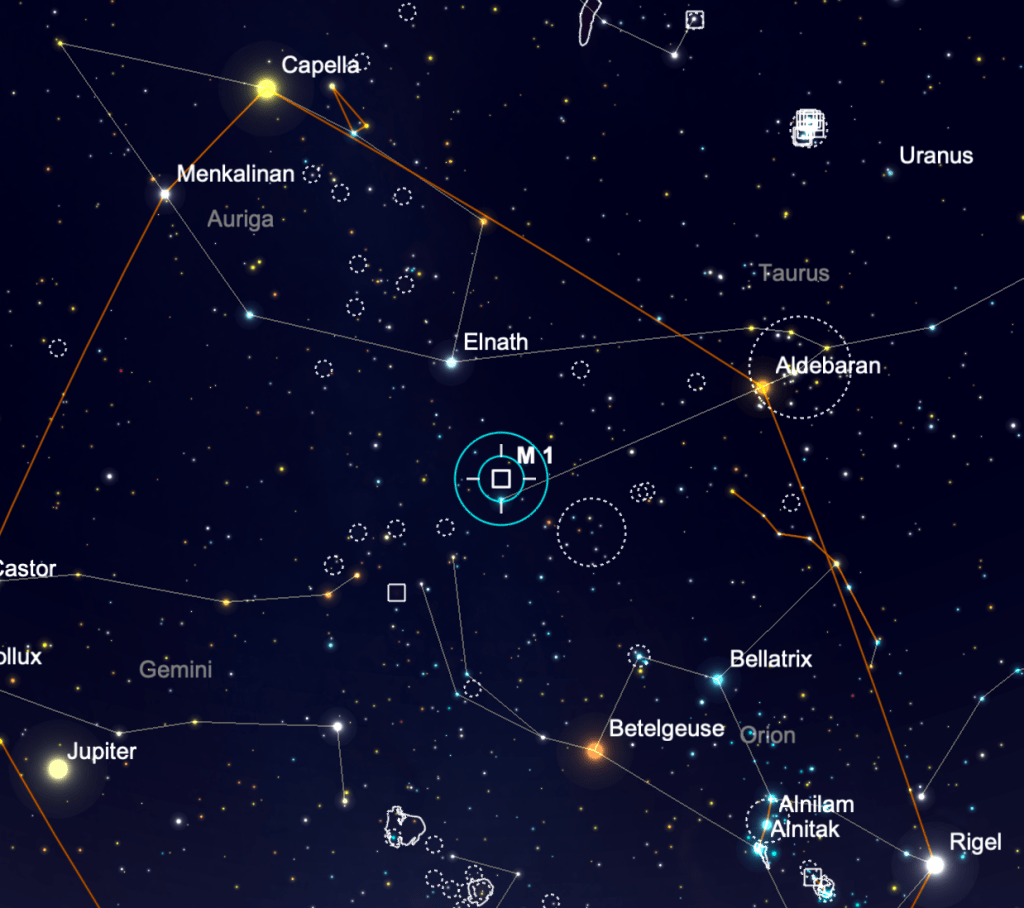
M1- a 1054 AD Supernova noted by Chinese astronomers created this nebula. Also possibly noted by Navaho in their Potroglyphs.
Bevis found the nebula remnant. Christened the “Crab Nebula” by Lord Rosse for it’s appearance through his large speculum telescope.
The Crab nebula is a supernova remnant in Taurus and appears as a hazy patch in small telescopes, large scopes can resolve some detail. It is difficult but possible to see in binoculars.
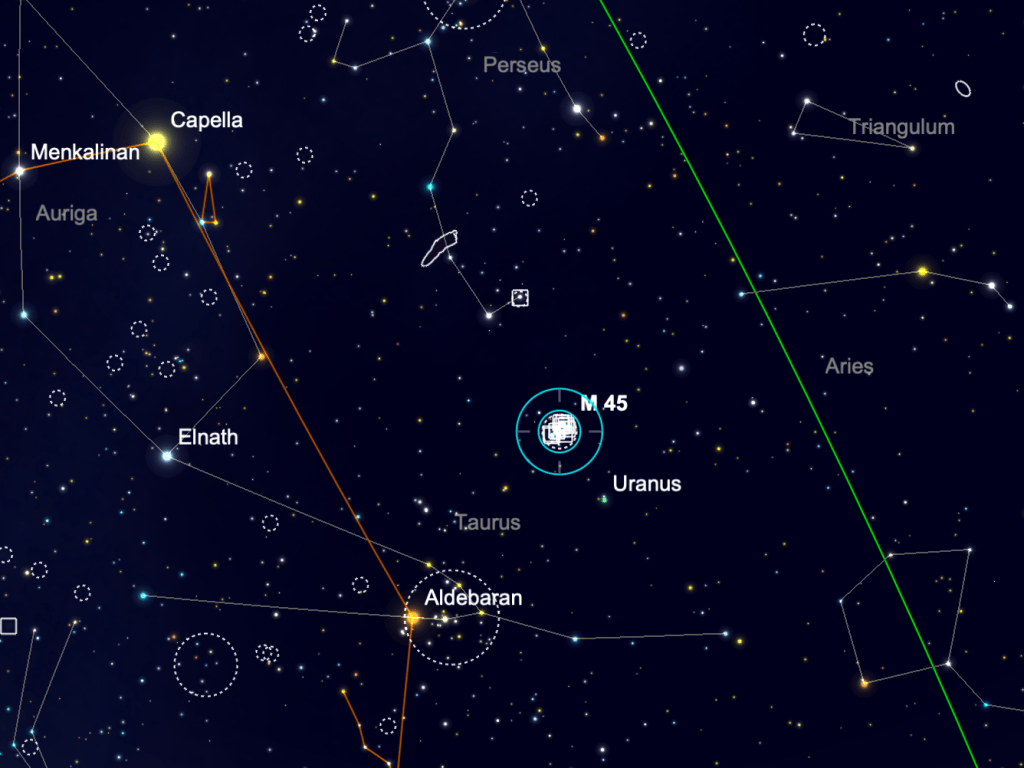
M45 – Possibly painted on Cave Walls dating back past 17,000 BCE.
Messier included it for his odd sense of 18th c. symmetry. 45 was seen as a nice round number.
The Pleiades are a large open cluster in Taurus. Easy to resolve six stars with the naked eye. Binoculars provide the best view. Small telescopes with clean optics can show some nebulosity. I think this nebulosity was something I spent a long time trying to see. I did extensive drawings a few years back with my binoculars and 100mm Takahashi.
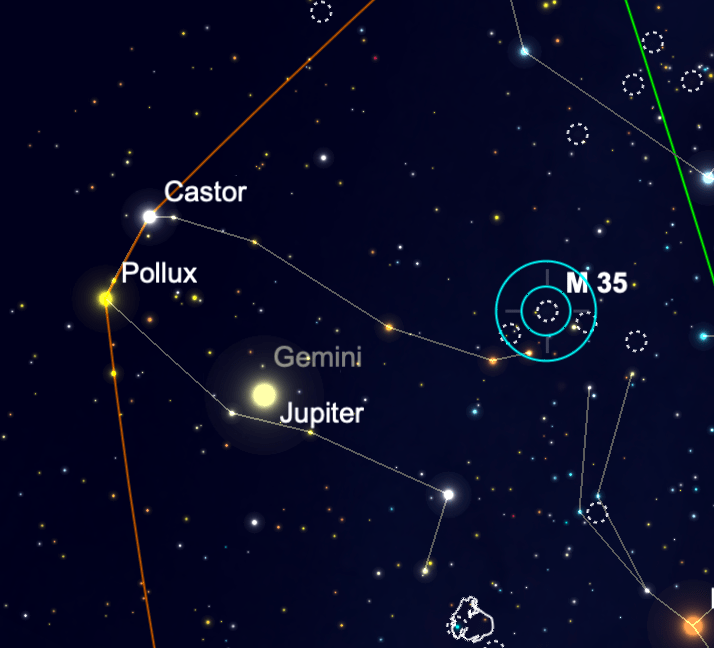
M35 discovered in 1745 by de Cheseaux
M35 in Gemini is a 5th magnitude open cluster and 40 arc minutes, so rather large.
Appears as a large fuzzy spot the the unaided eye.
Through telescopes you see many star chains and individual stars including some bright yellow and pale blue ones and notice NGC 2158 on the western edge.
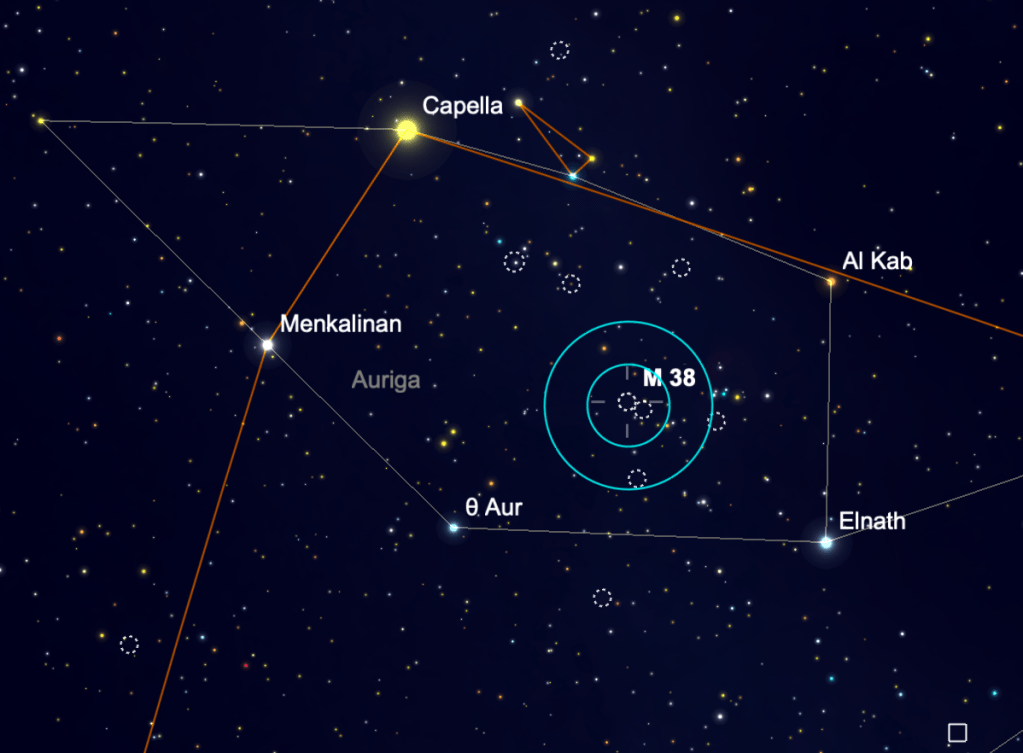
M37, M36, M38
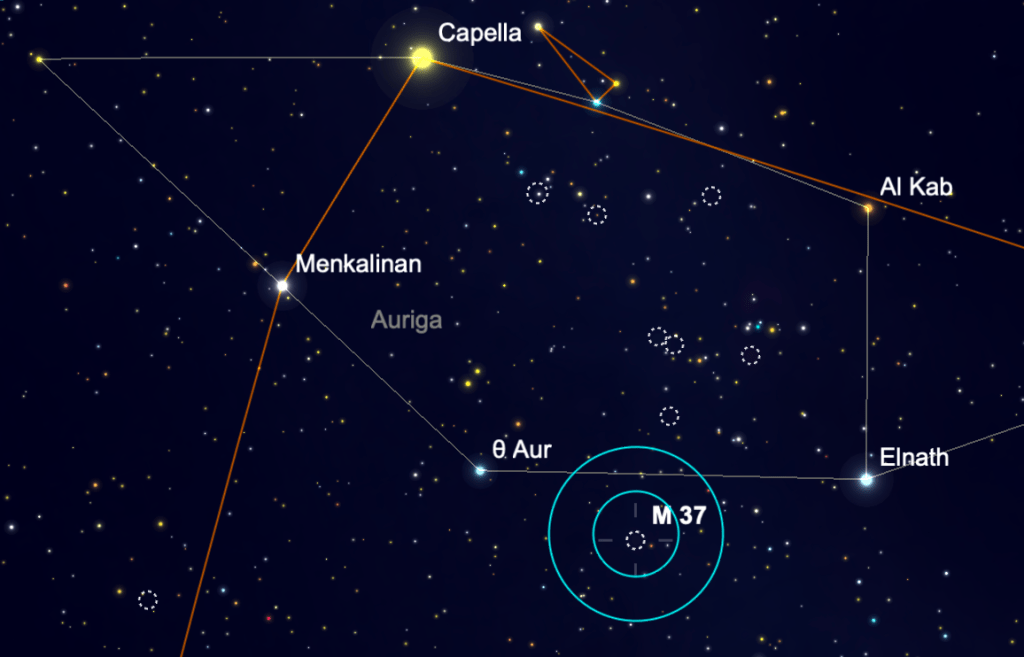
A series of open clusters in Auriga’s winter milky way and first seen by Hodierna in the early -mid 1600’s. All can be seen with the naked eye as faint fuzzy stars, binoculars reveal fuzzy patches, low power telescopes can resolve these rich clusters.
M38 is in the north and I usually start there, it is a reasonably bright cluster. 6.4 and 20 arc minutes.
M36 – 6th magnitude and 10 arc minutes.
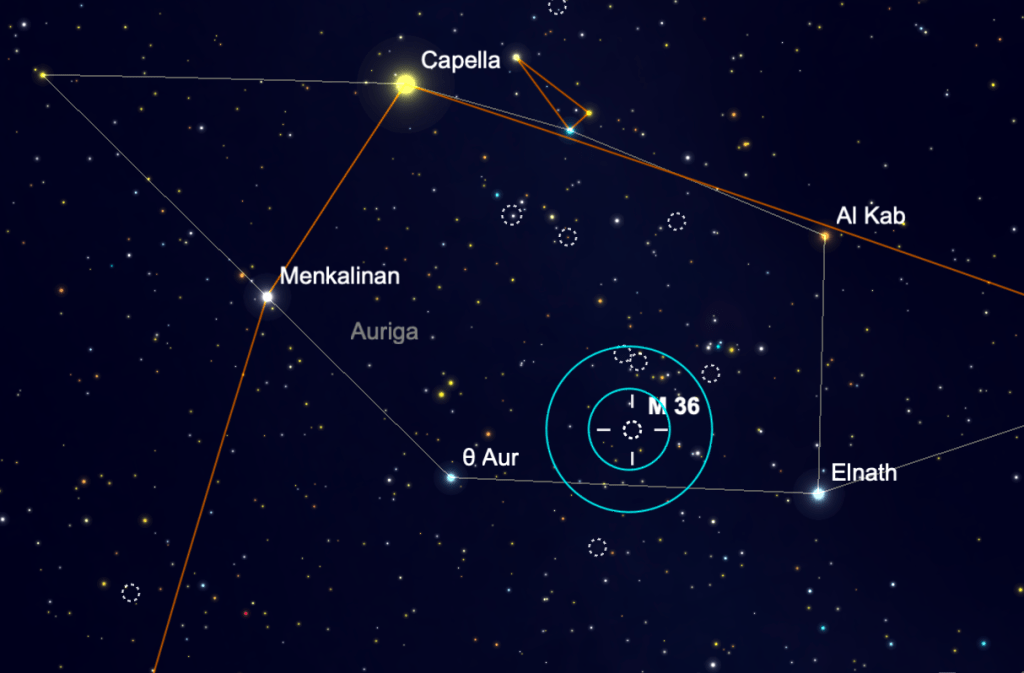
M37 – just brighter than sixth magnitude and 14 arc minutes
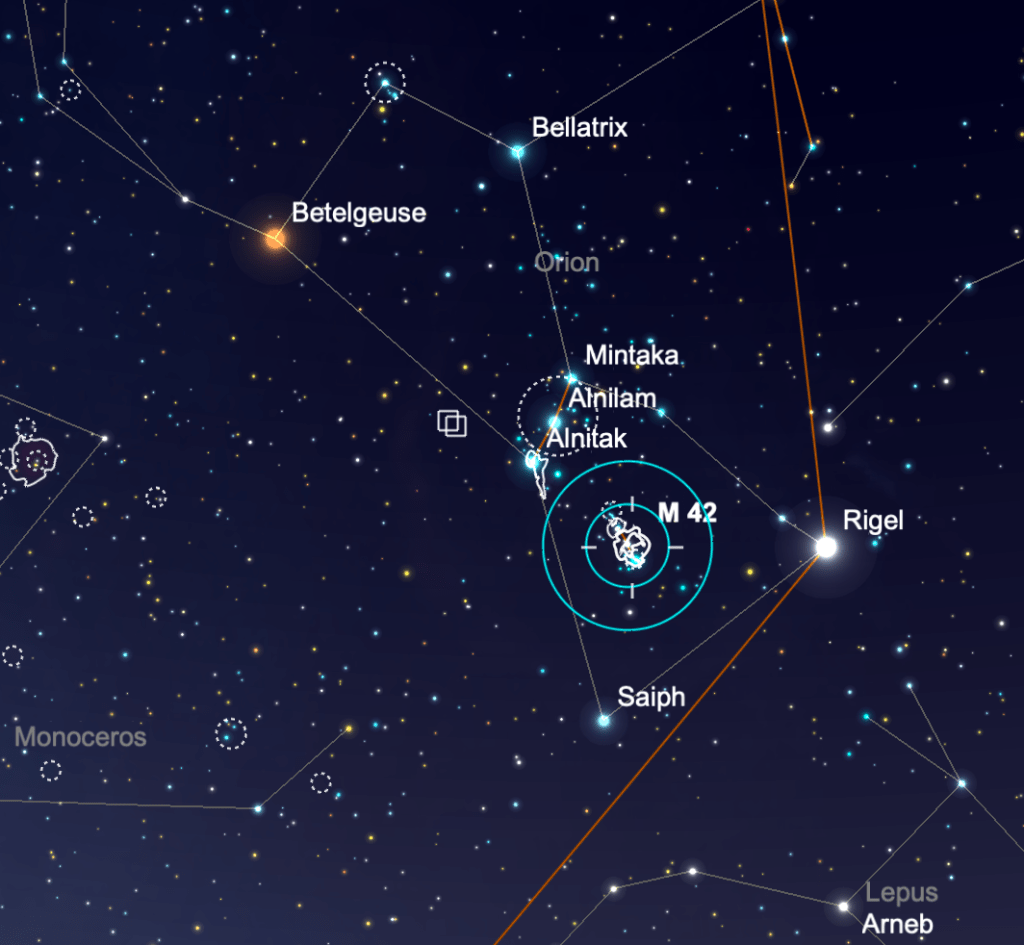
M42 & M43 the brilliant nebulae surrounding the bright stars of the sword of Orion.
M42 is 4th magnitude, 85×60 arc minutes so that’s over a degree in ea. Direction.
Piersec is credited with it’s discovery in 1610 but it’s brightest stars were known and catalogued as far back as Ptolemy. Curious since it is so bright.
M43 is credited as being discovered by de Marian in 1731 but at Magnitude 9 and 20×15 arc minutes it is far smaller than M42.
M42 is the great Orion Nebula. It can be seen as a fuzzy patch to the naked eye. Binoculars show some detail, and the view is superb in most any scope. M43 is a small region of nebulosity next to M42, and probably requires the use of a telescope to view. Use low to moderate powers for the best view of this pair.
M42 is a star forming region which shows a small grouping of stars in the “trapezium” at it’s centre. It has a huge batwing structure, might look a bit like a tulip, I’ve seen a deep red colour in my 5-inch and Mike’s 12-inch on many occasions.
M43 is part of the same nebula complex and lays to the north, separated by a band of dark nebulosity.
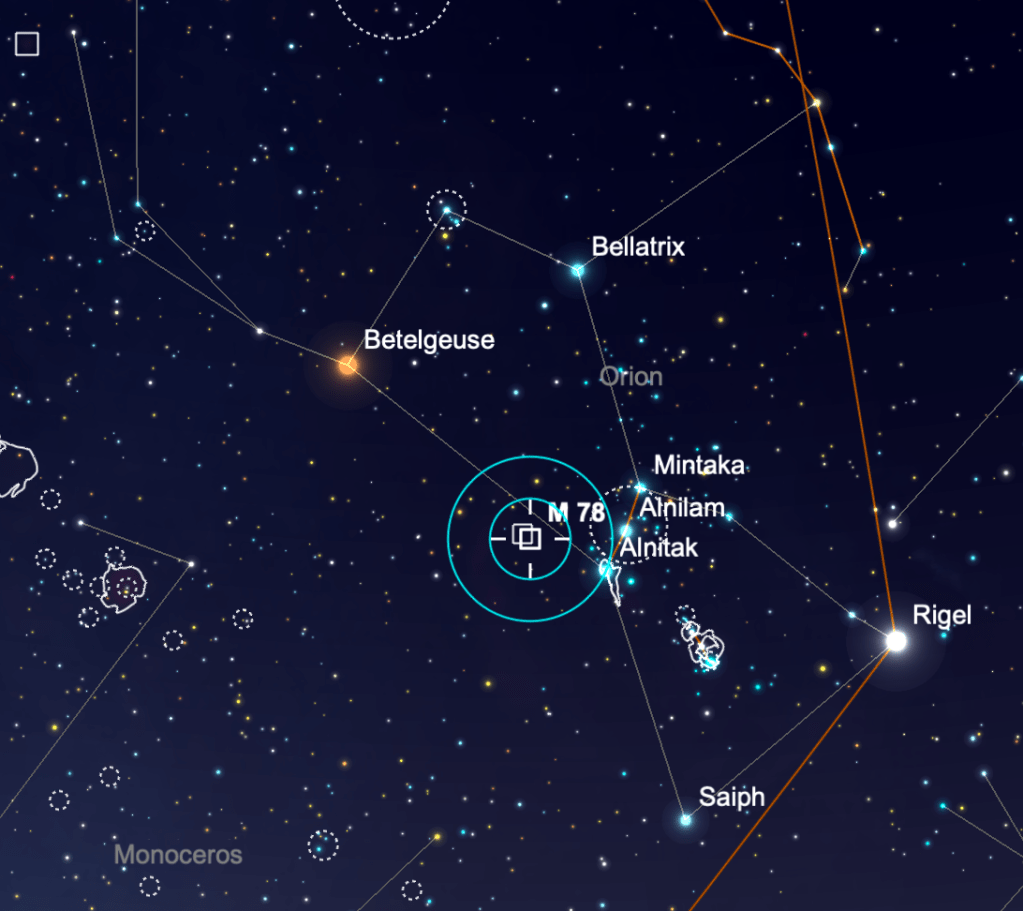
M78 – Discovered by Mechain in 1780 as an 8th magnitude object. Measures 8×6 arc minutes. You can find it ~3 degrees NE of Zeta Ori.
A small reflection nebula in Orion, one of the brightest reflection nebula. Best viewed in a telescope at moderate powers. I never find this responding well with filters.
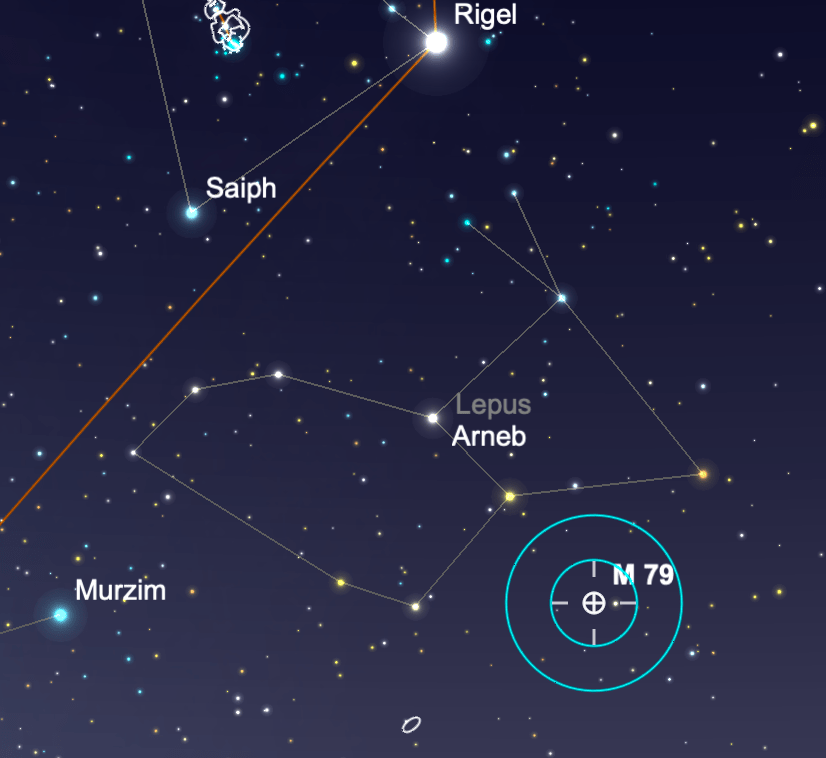
M79 – Mag. 7.7 , a globular cluster found in Lepus by Mechain in 1780 and is 9.6 arc minutes. Find it by drawing a line about 4-5 degrees down from the two, bright, close squares forming the backside of Lepus the Hare.
One of the smallest and dimmest globular clusters in the catalog. M79 is thought to have migrated from the Canis Major Dwarf Galaxy. A tough binocular object in Lepus, best viewed in a telescope at moderate powers. Low altitude makes it one of those Messier Objects people miss observing…like this year…most people would never get it here. It can be resolved in 8-inch and larger instruments.
 The Actual Astronomy Podcast