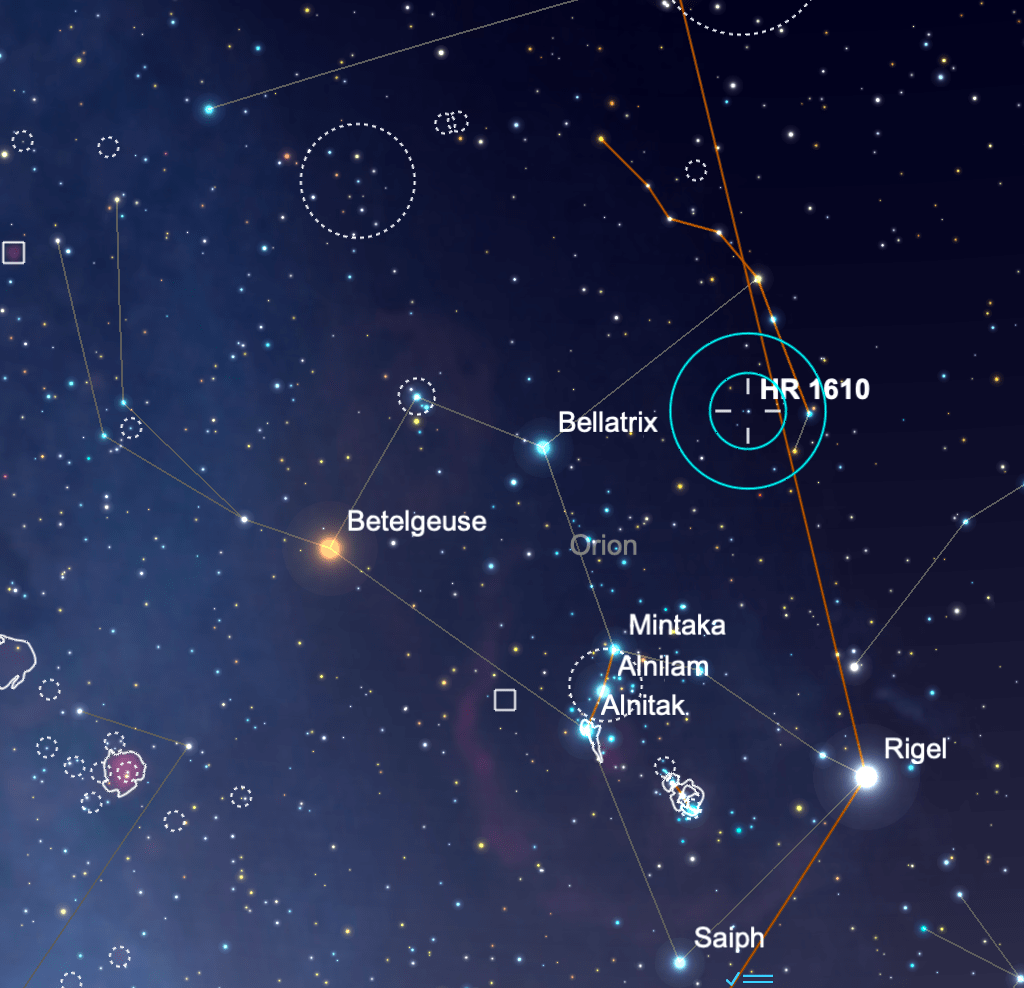
Jan 1 – Struve 627 in Orion Colourful Double Star
- Primary Star (A component): Yellow, golden-yellow, pale orange, or sometimes just white.
- Companion Star (B component): Bluish, blue-green, lilac, or pale green.
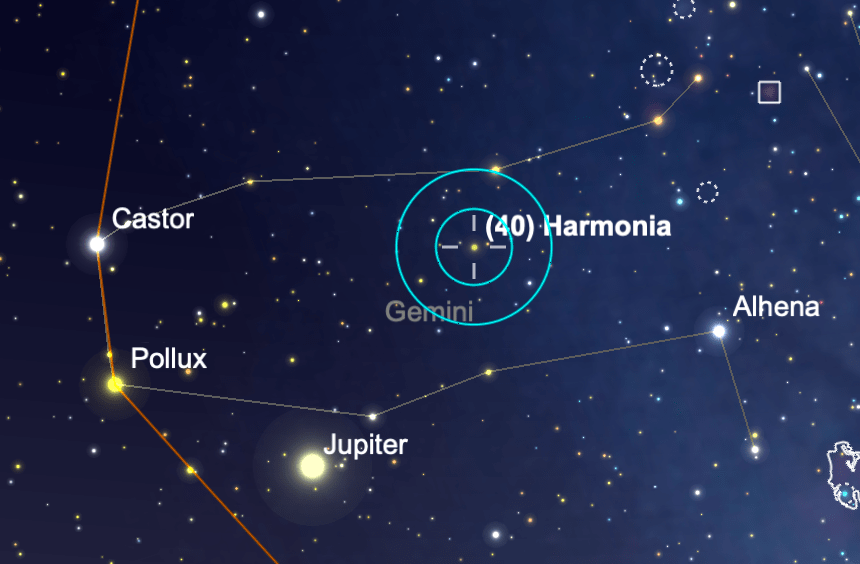
Jan 2 – 40 Harmonia at opposition
a large S-type (silicate) asteroid located in the inner region of the Main Asteroid Belt between Mars and Jupiter.
- Discovery: It was discovered on March 31, 1856, by German-French astronomer Hermann Goldschmidt.
- Naming: It is named after Harmonia, the Greek goddess of harmony and peace, to mark the end of the Crimean War.
- Size: It has a mean diameter of approximately 111.3 kilometers (69.1 miles), making it larger than 99% of all known asteroids.
- Orbit: Harmonia orbits the Sun every 3.42 years (approx. 1,250 days) with a relatively low eccentricity of 0.046, meaning its path is nearly circular.
- Rotation: It completes one full rotation on its axis every 8.91 hours
Jan 3 – Full Moon
- Quadrantid Meteors ZHR = 120 in Evening for NA observers
- Moon interferes
They are named after Quadrans Muralis, a 19th-century constellation that is no longer officially recognized.
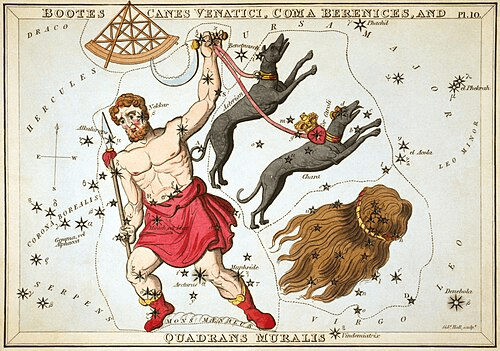
Constellation Origin: Lalande created the constellation to honor the mural quadrant, a large wall-mounted scientific instrument he and his nephew used at the observatory of l’École Militaire in Paris to measure star positions.
- Location: It was situated in the northern sky between the modern constellations of Boötes, Draco, and Hercules, near the “handle” of the Big Dipper (Ursa Major).
- Decline: In 1922, the International Astronomical Union (IAU) omitted Quadrans Muralis when it formalized the official list of 88 modern constellations, reassigning its stars to neighboring constellations
- Jan 5 – Sig Orionis colourful double star
- Sigma Orionis AB: This is the brightest component of the system and is a very close binary that appears as one star in most amateur telescopes. It is actually a triple system itself (Aa, Ab, and B).
- The primary stars (Aa and Ab) are highly massive, very hot blue stars that orbit each other every 143 days.
- The outer component (B) orbits the inner pair every 157 years.
- Sigma Orionis C, D, and E: These are additional companion stars that are farther from the AB pair and can be observed with small-to-medium sized telescopes, making the system appear as a beautiful quartet or quintuple system.
- Component D is magnitude 6.62 and is about 13 arcseconds from the AB pair.
- Component E is magnitude 6.66 and is approximately 41 arcseconds away. This star is notable as the prototype of the rare “helium-rich” stars.

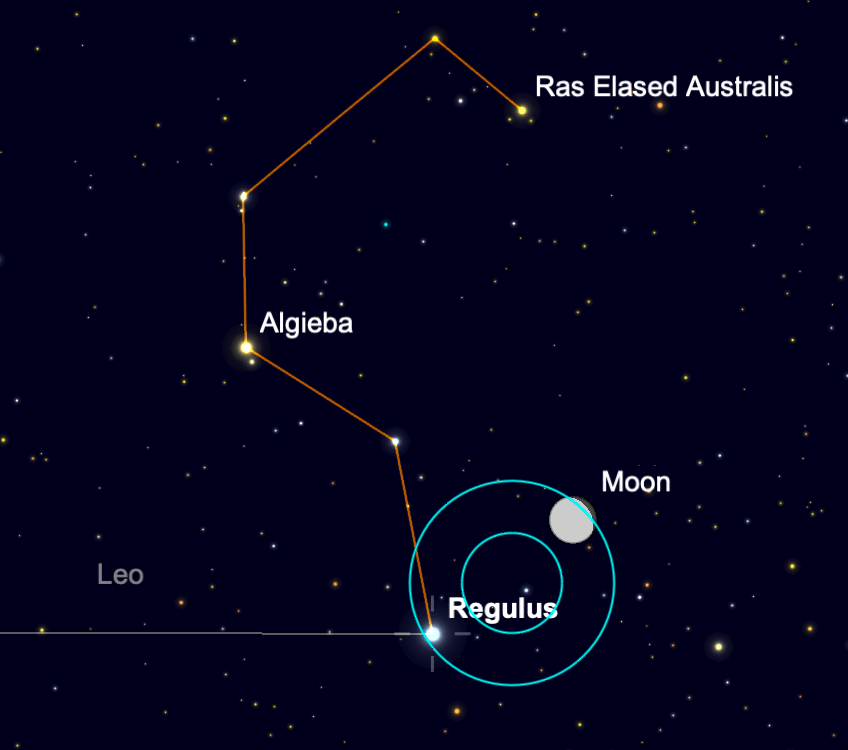
Jan 6 – Regulus 0.5-degrees South of Moon
Jan 8 – 24P Schaumasse Comet just cracks 8th magnitude, at Mag. 7.9 it is firmly a Bino comet
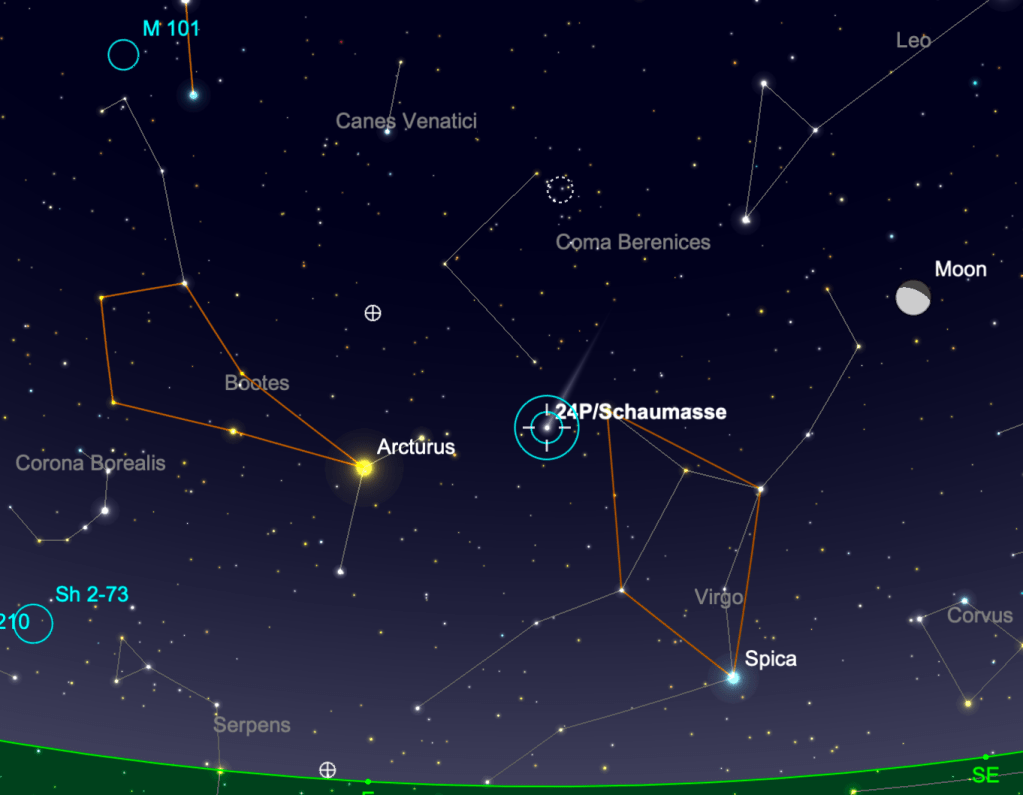
January 10 – Last Quarter
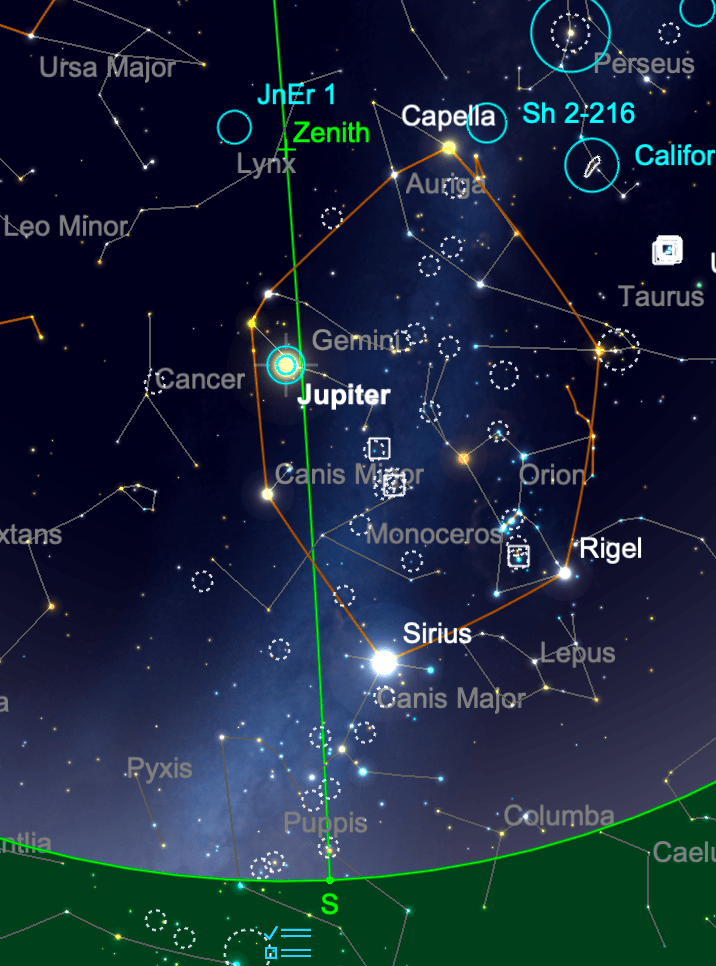
– Jupiter at Opposition – mag. -2.5, 46 arc seconds in Gemini
- GRS looks nice and Orange/Red
- NEB and SEB are prominent
- How to best observe? Powers/Filters/Bino viewers
- Book rec. Jupiter and How to Observe It by John McAnally
– NGC 1851 well placed but I’d need to dig a trench to see it

– Carbon Star RV Monoceros
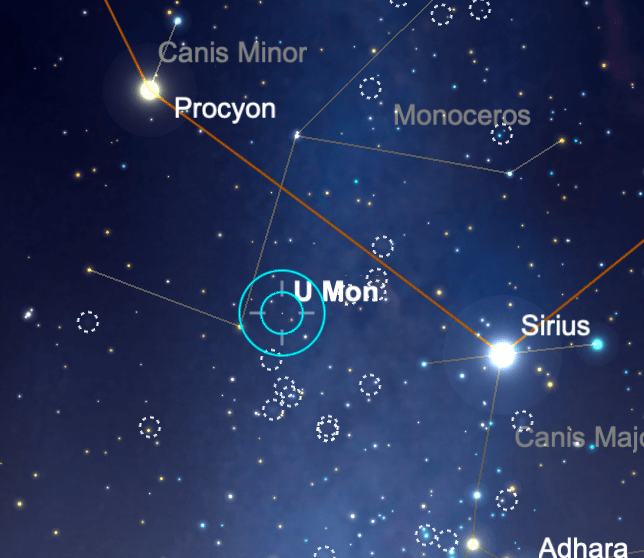
Jan 11 -Follow Arcturus into daylight this week
– M79, M42, M43, M78 well placed
Jan 12 – Lunar Curtis X visible
Jan 14 – Antares 0.6-degrees N of Moon – not for us
– NGC’s 1807 and 1817 well placed
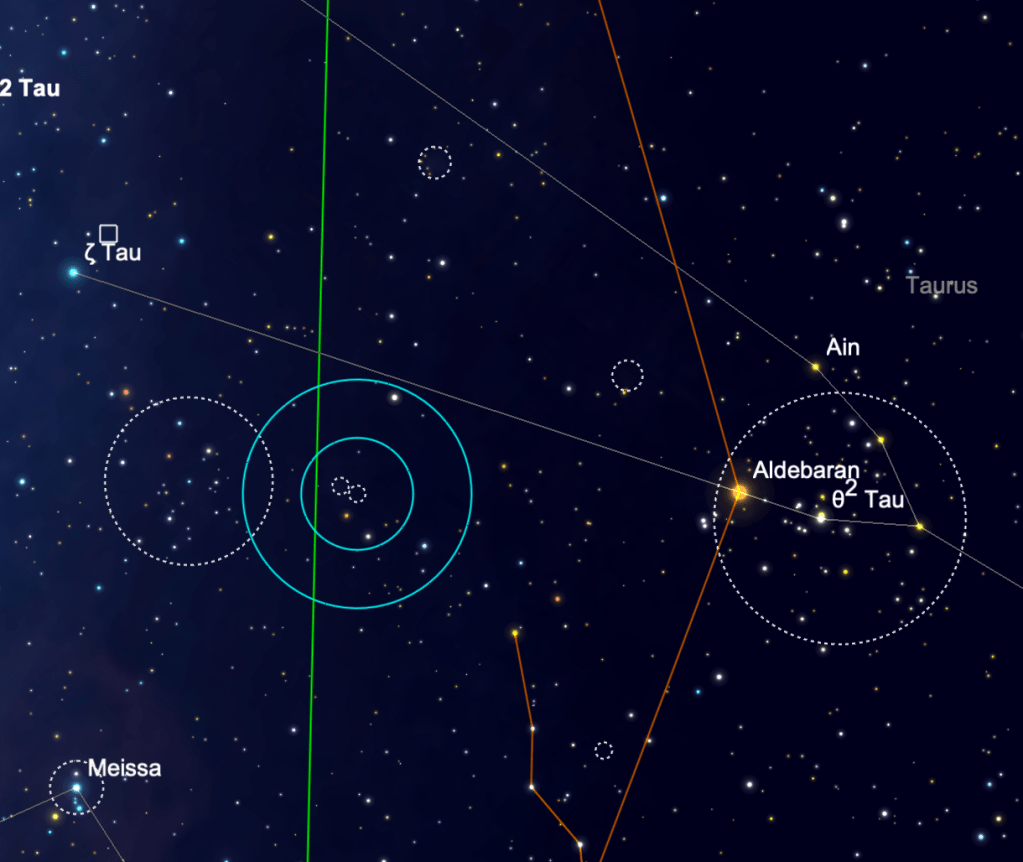
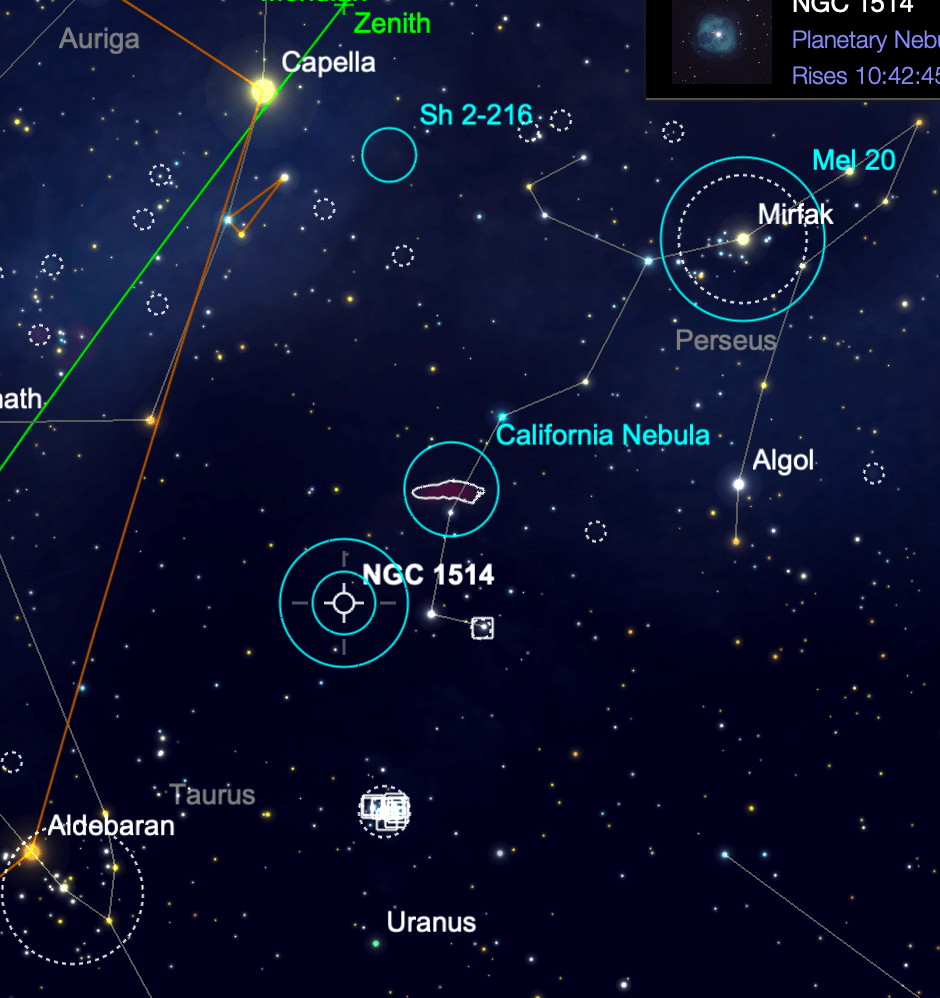
Jan 15 – NGC 1514 well placed
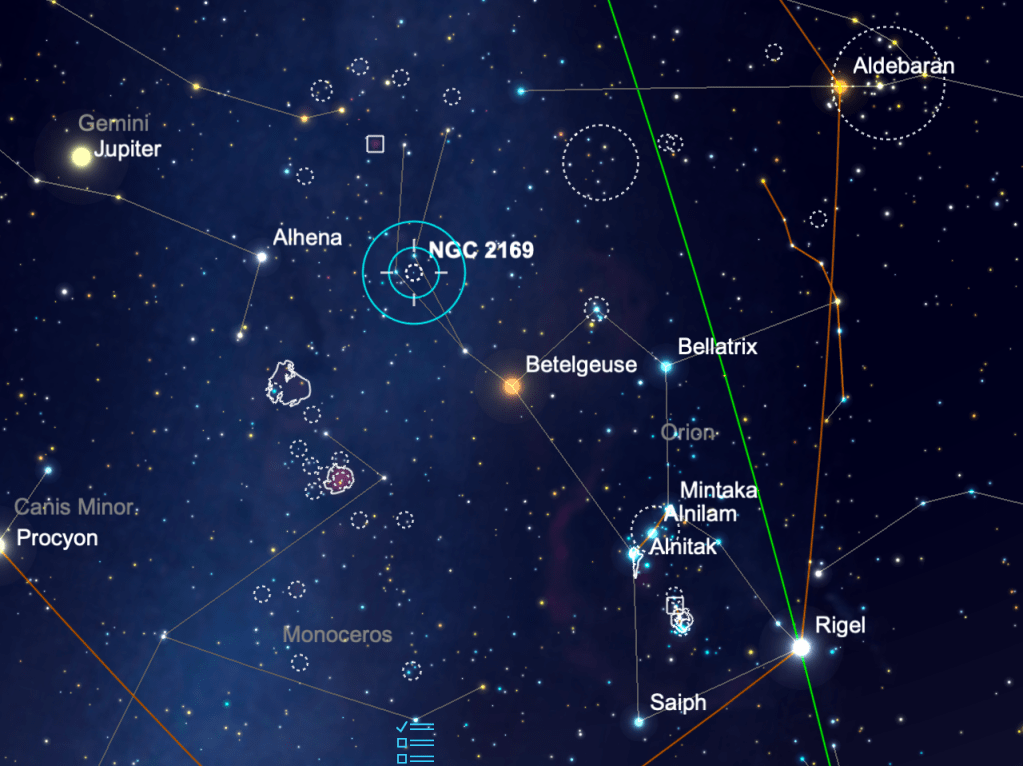
Jan 17 – NGC 2169 well placed
Jan 18 – New Moon
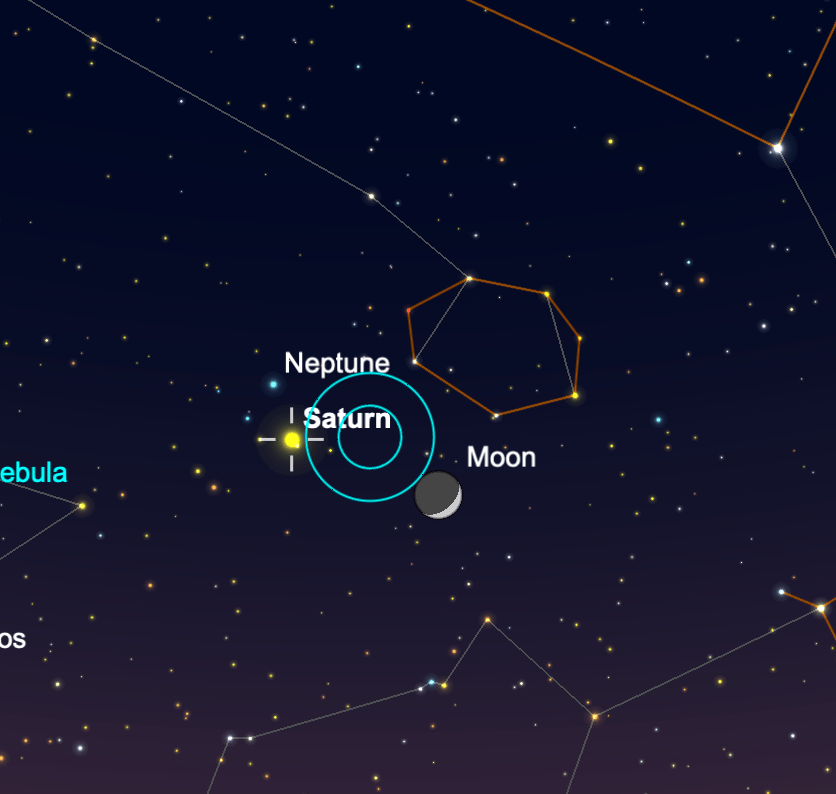
Jan 23 Saturn, Neptune 4-degrees S of Moon
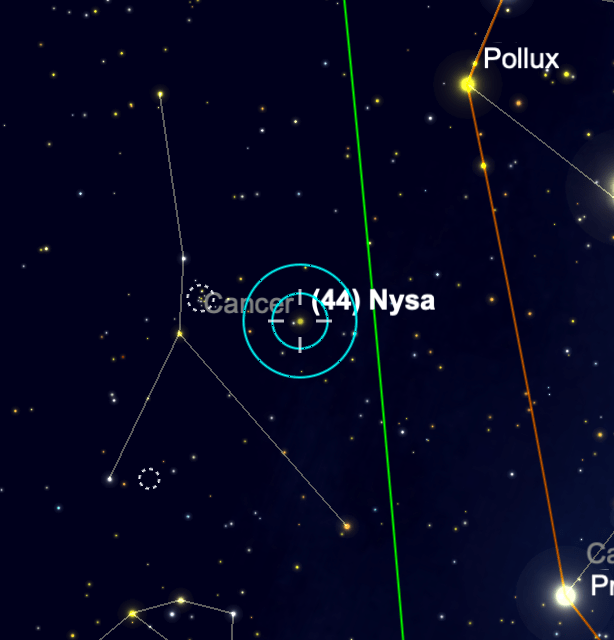
44 Nysa at Opposition M=8.8
- Largest and brightest of Nysian Family of Asteroids
- It was discovered by Hermann Goldschmidt on May 27, 1857, and named after the mythical land of Nysa in Greek mythology
M3, M5 well placed
Jan 26 – First quarter
– Lunar Straight Wall
– Eyes of Clavius
Jan 28 – Jewelled Handle on Moon
Jan 31 Jupiter 4-degrees S of Moon
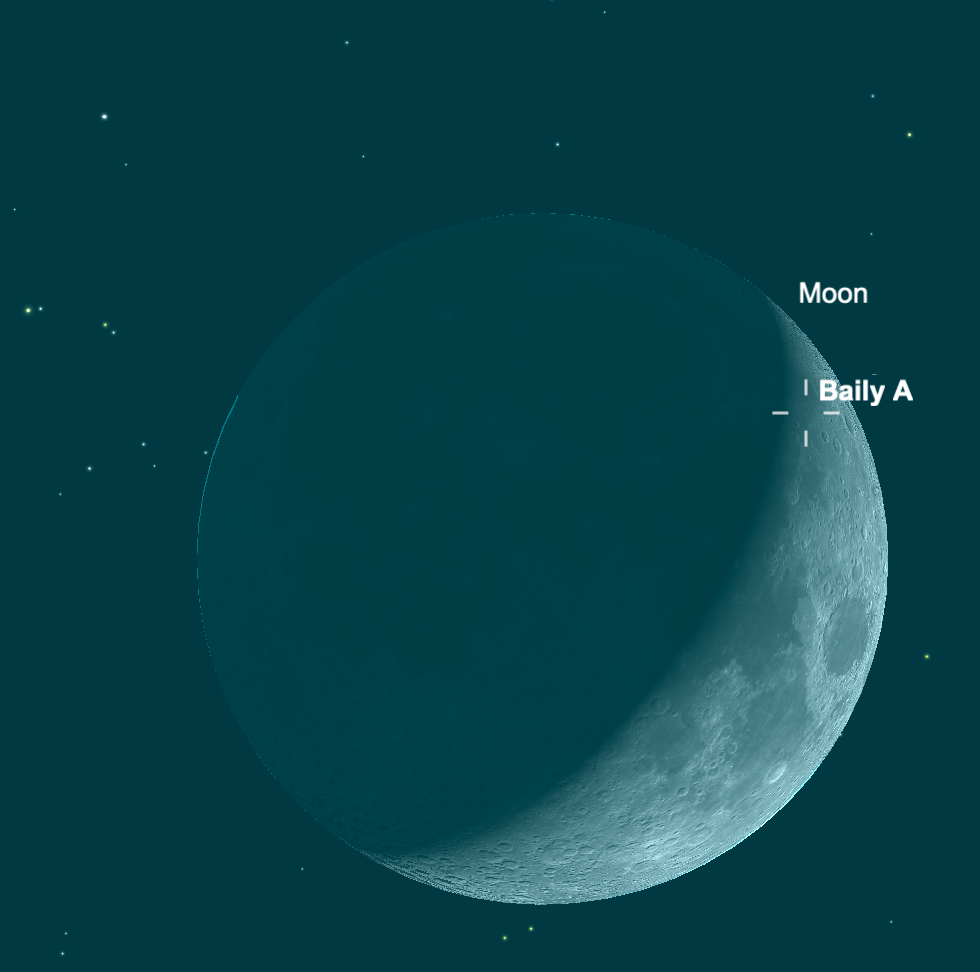
Crater Baily
 The Actual Astronomy Podcast
Amazing content, like usual
LikeLike