(Dave Chapman, 2023)
Focussing on classic Greek-Roman names with occasional indigenous references. The classic names are used in some GoTo telescope software for sky alignment (e.g. Sky-Watcher SynScan and Celestron).
Spectral classes O B A F G K M — Annie Jump Cannon
References:
Star Tales (2018) Ian Ridpath
Star Names (1963) Richard Hinckley Allen
Sky Safari 7 Pro (star lore by Jim Kaler)
A Concise Dictionary of Astronomy (1991) Jacqueline MItton
Stars You Should Know—Southern Skies Edition
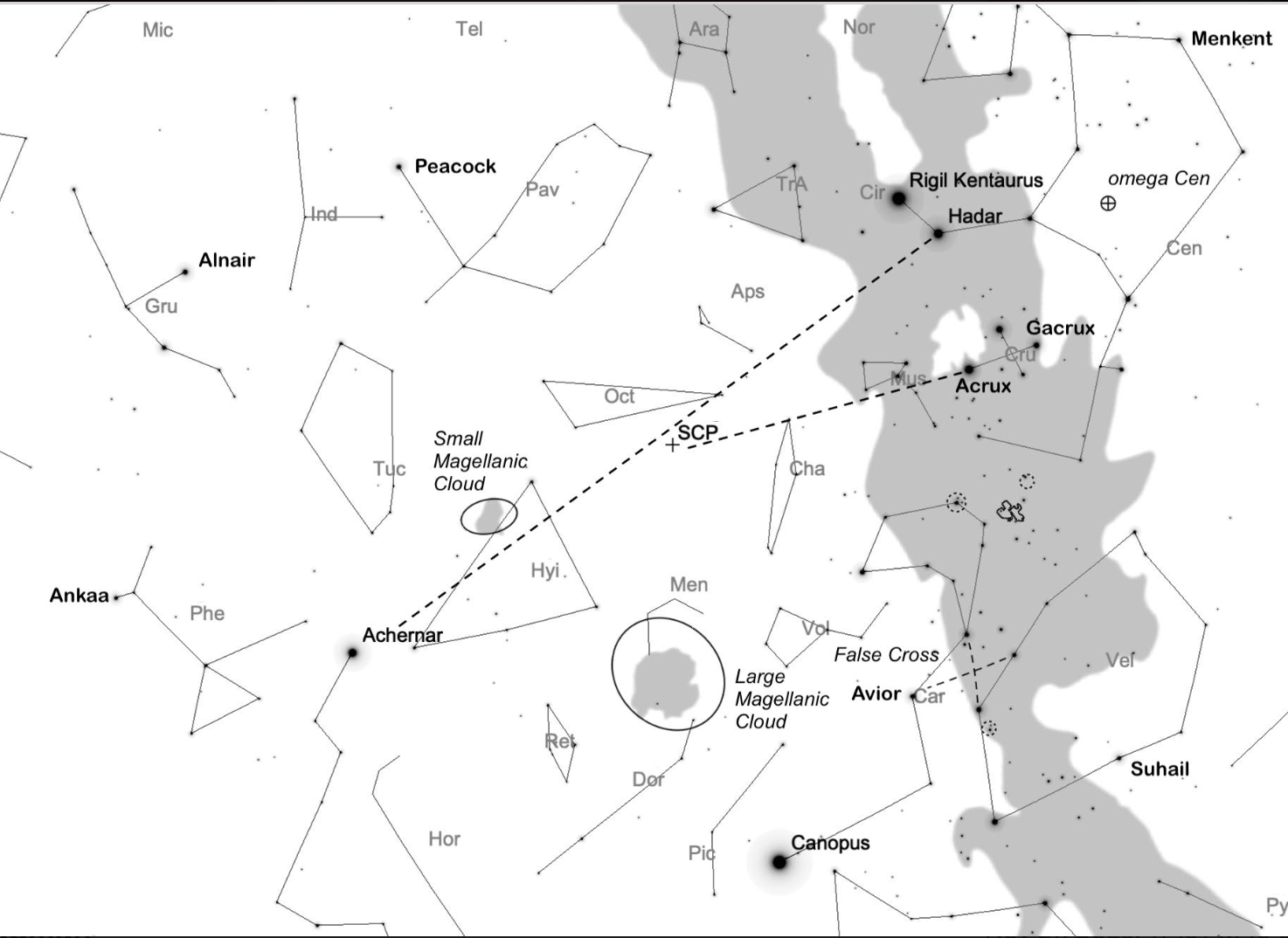
12 bright stars —from mag. –0.6 to mag. 2.4
—all 12 are used for celestial navigation (won’t mention again)
—all 12 are used by Celestron as alignment stars (won’t mention again)
—only 1 is used by Sky-watcher as an alignment star
—all visible from extreme southern continental USA and Caribbean
ARGO NAVIS —large, ancient constellation
—broken up into CARINA (keel), PUPPIS (stern), and VELA (sails)
—Nicolas Louis de Lacaille (1756)
CARINA Keel (or Hull) of Argo Navis
Canopus alpha Car (Ship’s Pilot)
– mag. –0.6, A9 white supergiant
– associated with the sci-fi novel Dune (planet Arrakis is Canopus III)
– second-brightest star in the night sky, south of Sirius
– used for navigation of spacecraft
Avior epsilon Car (named by Her Majesty’s Nautical Almanac Office in 1930s)
– mag. 1.9 variable spectroscopic binary star, K3 orange
– brightest member of “False Cross” sometimes mistaken for Crux
CENTAURUS The Centaur (Chiron, son of Cronus and father of Ophiuchus)
Rigil Kentaurus alpha Cen (The Foot of the Centaur)
– mag. 0.0, triple star, G2 yellow
– 3 rd brightest star in night sky
– nearest star system to Earth (Proxima Centauri over 2 degrees separation)
Hadar beta Cen (One of a Pair?)
– mag. 0.6 variable star, B1 blue-white
– Hadar and Rigil are “pointers” for Crux
– omega Centauri globular cluster not far
Menkent theta Cen (Shoulder)
– mag. 2.1 binary star, K0 orange
– visible from Canada
ERIDANUS The River (The Nile?)
Achernar alpha Eri (End of the River)
– Mag. 0.5 multiple star, B3 blue-white
– “End of the River” used to be another star named Acamar
– Southern celestial pole about halfway between Achernar and Hadar
CRUX The Southern Cross
– Featured on flags of Australia, New Zealand, Brazil…
– Important in the star lore of several cultures
– Known to Ptolemy in Alexandria but precession moved it south
Acrux alpha Cru
– mag. 0.7 multiple star, B0.5 blue-white
– nice double in small telescope
Gacrux gamma Cru
– mag. 1.6 variable multiple star, M3.5 red-orange
– Acrux and Gacrux point to southern celestial pole (no bright star)
GRUS The Crane
Alnair alpha Gru (The Bright One)
– Mag 1.7 subgiant B7 blue-white star
– same name as zeta Cen
– sparse area of southern sky
PAVO The Peacock
Peacock alpha Pav (Peacock)
– mag. 1.9 subgiant multiple star, B2.5 blue-white
– sparse area of southern sky
– named in 1937 by UK Nautical Almanac Office
VELA The Sail of Argo Navis
Suhail al Muhlif gamma Vel (The Glorious Sta of the Oath)
– gamma1 is mag 1.8 multiple star, O7.5 blue star
– gamma2 is mag 2.2 multiple star, K4 orange-red
– no alpha or beta in Vela—gamma is the brightest
– modern name Regor (astronoaut Roger Chaffee, named by Gus Grissom)
– lambda Vel also named Suhail!
PHOENIX The Phoenix
Ankaa alpha Phe (Phoenix)
– mag. 2.4 spectroscopic binary, K0 yellow-orange
– only Sky-watcher alignment star in this list
– sparse area of southern sky
 The Actual Astronomy Podcast